The Perimenopausal "Chin Hair Ambush" Doctors Won't Prepare You For (And The 5,000-Year-Old Ritual That's Replacing The $11B Hair Removal Industry For Women Over 40) The published research the hair removal industry buried for 14 years. The one thing laser can't do that this can. And why 85% of women in the trial reached zero hair count in six months.
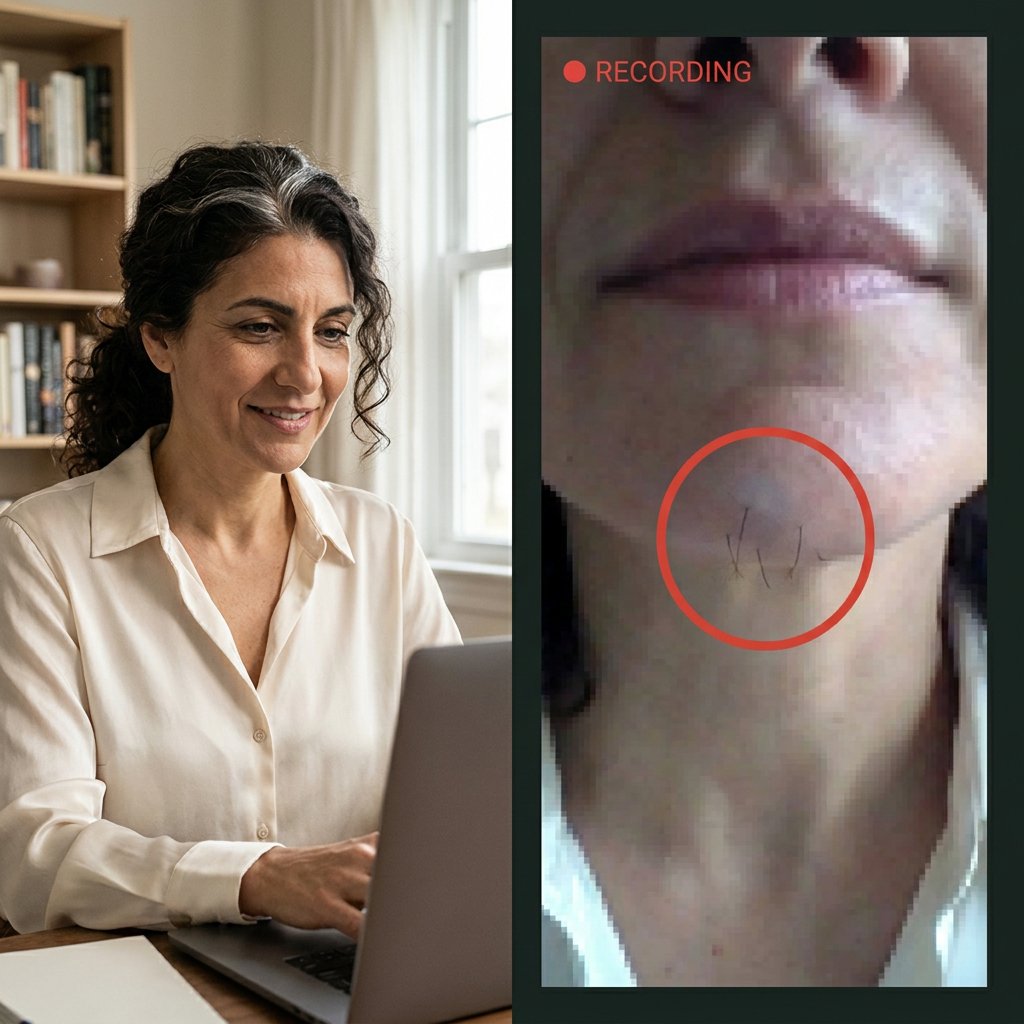
I'm going to tell you something I've never told anyone — not my husband, not my sister, not my best friend of twenty years.
I'm 47. I've spent the last four years tweezing my chin at red lights. In office parking lots. In the Target bathroom. Once, memorably, in the Uber on the way to my daughter's piano recital, hunched over a hand mirror while my husband stared out the window pretending not to notice.

I've spent $5,705 trying to make it stop. Laser. Vaniqa. Three different creams. A dermaplane tool I bought at 2am. A salon that charges $65 every two weeks to thread me and lectures me about "hormonal imbalance" like it's news.
None of it worked.
What finally worked was something a dermatologist I met on a work call told me about — almost offhand, like she was embarrassed to recommend it. She said her grandmother in Beirut did it. She said there's actual published research on it. She said the entire $11 billion hair removal industry has been quietly ignoring it for fifty years because you can't patent a plant and you can't subscribe someone to a piece of string.
Six months later, I'm hair-free for the first time since I was 42.
This is the story of what I learned. And why, if you're a woman over 40 reading this on your phone at midnight because you can't sleep, I think it might change your life too.
The Morning My 15-Year-Old Daughter Walked In On Me at 6AM

It was a Tuesday in March. I had a 7am client call — I'm a counselor, I work with women navigating divorce, and that particular woman was in week two of hers and couldn't wait.
I'd been in the bathroom since 5:52am. Harsh overhead light. Tweezers in my right hand. Hand mirror in my left. I was 11 minutes in and still finding them.
Nora opened the door.
She was supposed to be asleep. She wasn't. She was 15, dressed for cross-country practice, standing in the doorframe with the hallway light behind her.
She said: "Mom, what are you doing?"
I said: "Nothing, honey. Go back to bed."
She said: "You've been in here for an hour."
I didn't have an answer. I just stood there holding the tweezers.
After she left, I sat on the edge of the tub and cried for ten minutes. Not because of the hair. Because of the time. Because I had been doing this, every single morning, for four years. Because my daughter now knew. Because somewhere in the last decade I had become a woman who hid in bathrooms at dawn.
I was late to my 7am call. The client — Sarah — was gracious. She said she'd been crying too. We had a good session.
Afterward, I had a 10am Zoom with a dermatologist friend about something totally unrelated — a referral for one of my clients. Her name was Dr. Layla Haddad. I'd known her casually for about two years.
She asked how I was doing. I almost said "fine."
Instead, for some reason, I told her the truth.
The One Sentence a Dermatologist Said That Made Me Rethink the Last 15 Years

I told Layla about the tweezing. The 5am bathroom. Nora in the doorway. The $5,705. All of it.
She didn't say anything for a long moment. Then she said one sentence I'll never forget:
"Lauren, the industry has known what works since 1972. They just haven't been selling it to you — because they can't."
Then she told me about her grandmother.
Her grandmother was born in Beirut in 1931. She was threading her face by age 16. She threaded her mother, her sisters, her daughters, her granddaughters. Four generations of women in that family have never once bought a razor, a cream, or a laser session. And none of them — not one — has visible facial hair past age 50.
Layla said it was the same in Egypt. The same in Iran. The same in Pakistan, India, Turkey, Jordan, Morocco. A region of the world where millions of women have been doing this exact thing for approximately 5,000 years, and the facial hair rates among women over 50 in those cultures are a fraction of what they are in the West.
And it's not just the thread, she said. It's the thread plus an oil. A specific plant oil. Called Cyperus rotundus.
I'd never heard of it.
She said: "You wouldn't have. It's not on any shelf in America. The research is in a journal most dermatologists don't read. The plant is considered a weed in the U.S. — the USDA literally classifies it as invasive. But in the Middle East, women have been grinding it into oil for 5,000 years and applying it after threading. There are studies, Lauren. Multiple studies. One from 2012 — 85% of women in the trial reached zero hair count after six months."
She paused.
"The reason nobody has sold it to you is because you can't patent a plant and you can't subscribe someone to a piece of string. There's no $200-a-month recurring revenue in it. So the industry built everything else — the lasers, the creams, the subscription boxes — and let the ritual get forgotten."
I made her repeat the plant name twice. I wrote it down. I spent that entire night Googling.
Everything she said was true.
Your Hormones Started the Fire. The Chemical Cream Industry Is Why It Never Goes Out.
Here's what I learned over the next three weeks, in order.
Perimenopausal facial hair is real. It happens to roughly 40% of women over 45. Your estrogen drops. Your androgens stay roughly the same. The ratio shifts. Fine vellus hair on your chin and upper lip gets a signal to convert to terminal hair — the thick, dark, coarse kind. This is biology. There is nothing wrong with you.
Hormones started the fire.
But the fire is a hair cycle. The follicle sends up a hair. You remove the hair. The follicle sends up another. Repeat forever. That's not hormones anymore — that's just the cycle doing its job.
The question is not how do I stop my hormones (you can't — not without hormone replacement therapy, which has its own tradeoffs). The question is how do I interrupt the follicle cycle so new hairs come in slower, finer, and eventually not at all.
And here's the devastating part I didn't know:
Nothing you can buy at CVS, Sephora, or your dermatologist's office actually does this.
- Nair, Veet, chemical depilatories — dissolve the hair at the skin's surface. Follicle untouched. Hair returns in 72 hours. Chemical burn risk. (Have you ever actually read the warning label on Nair?)
- Shaving — same surface problem. Plus skin irritation. Plus (yes) it does make hair feel coarser as it grows back because you've created a blunt cut edge.
- Laser & IPL — targets the melanin in the hair follicle. Which means it cannot see white, grey, or very fine light hairs. If you're perimenopausal and your chin hairs are coming in white or grey — which is what happens with age — laser literally cannot find them. $3,400 of my money went into a laser that was targeting hairs that didn't absorb its light.
- Vaniqa (eflornithine) — a prescription cream that slows (not stops) hair growth. Discontinued in the U.S. in 2023. Worked only while you used it. $200/month. Returns within weeks of stopping.
- Dermaplaning — a fancy razor. Surface only.
- Salon threading — removes the hair at the follicle, but it's just removal — no treatment to slow regrowth. You're back in two weeks. $65 a session.
Every one of these treats the symptom. None of them interrupts the cycle.
And so the industry has you on a treadmill — tweezing, waxing, lasering, creaming, subscribing — forever. Because the only thing that actually interrupts the cycle is something they can't sell you with a 20% recurring margin.
Hormones started the fire. The chemical cream industry is why it never goes out.
There Are Only Two Mechanisms That Actually Reach the Follicle. Nothing on Your Bathroom Counter Uses Either One.
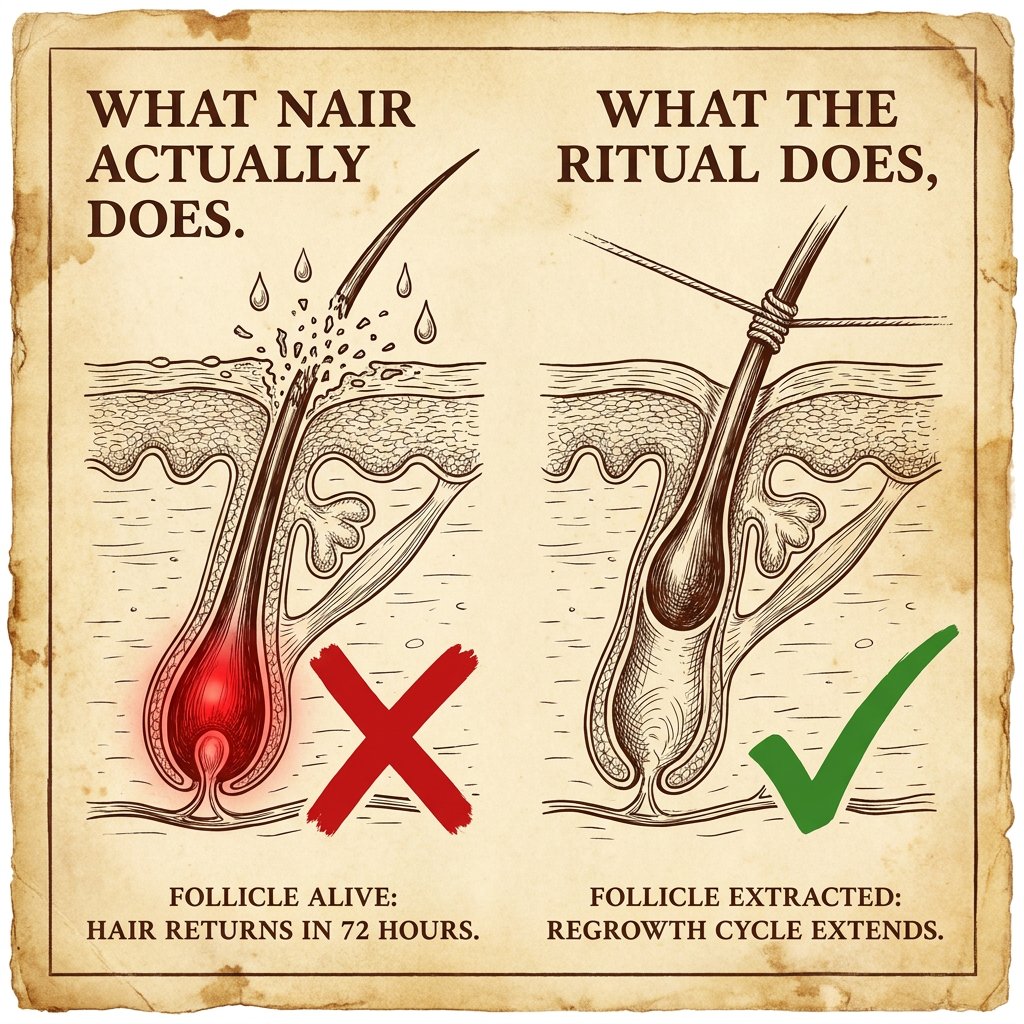
Dr. Haddad walked me through this on a follow-up call. She drew it on her tablet.
There are exactly two mechanisms that can actually interrupt the follicle cycle:
Mechanism 1 — Mechanical root extraction. You physically pull the hair out from the root. Not break it off at the surface. Not dissolve it chemically. Remove the entire shaft, bulb and all. This forces the follicle into a longer dormancy phase before it can produce another hair. Done repeatedly over months, the follicle gets confused and weak. New hairs come in finer. Then slower. Then not at all.
Threading does this. Tweezing does this (barely — you miss the deep ones). Waxing does this (but tears skin). Epilators do this (but hurt and miss facial contours).
Mechanism 2 — Follicle-targeting botanical. There are a small number of plant oils that have been shown in published research to interact with the hair follicle's growth signaling pathway and slow down the regrowth cycle. The best-studied is Cyperus rotundus — the plant Layla's grandmother used.
A 2025 review in Dermatological Reviews (Wiley) catalogued roughly 192 compounds that have been characterized from Cyperus rotundus since 1965 — including sesquiterpenes and other plant constituents that researchers have been studying for how they interact with the hair follicle growth pathway. In plain English: it's not one mystery ingredient. It's a plant with a long chemistry resume, and women in the Middle East figured out which part to use long before any journal did.
You know what uses both of these mechanisms together?
Nothing on your bathroom counter.
Nothing in any laser clinic.
Nothing any dermatologist in America will prescribe you.
The only thing that uses both mechanisms is the ancient ritual — thread + oil — practiced by women across the Middle East, North Africa, and South Asia for approximately 5,000 years.
And until very recently, there wasn't a single company in the United States selling it as a kit.
For Years, Nobody Was Selling the Thing That Worked. Here Is What Changed.
There's a reason the ritual stayed buried in the Middle East for so long. Actually, there are three reasons.
Reason one: Traditional threading requires two hands, your teeth, and years of practice. It's an inherited skill — grandmother to mother to daughter. If your grandmother didn't do it, you don't know how to do it.
Reason two: Cyperus rotundus doesn't grow commercially in the U.S. The plant is literally classified as an invasive weed by the USDA. The oil has to be sourced from traditional growers in Egypt, Jordan, and parts of South Asia. No American beauty brand wanted the supply-chain headache.
Reason three — and this is the big one: It can't be forced into a monthly subscription model. The kit is a one-time purchase. The device lasts years. The oil runs about a bottle every few weeks of twice-daily use, and you can reorder refills whenever you need them — but nothing auto-charges you, nothing auto-ships, and no part of the kit is held hostage behind a subscription you'd have to cancel. The entire economic model of the modern beauty industry is recurring revenue — monthly subscriptions, auto-ship, ongoing laser packages. A kit that just works, without locking you into anything, doesn't fit the spreadsheet.
So for years, nobody built it.
Then, three years ago, a small team — including Dr. Haddad as an advisor, though I didn't know this at the time — decided to build it anyway. Not as a subscription. Not as a monthly recurring product. As a one-time kit with a six-month supply, built around a rechargeable rotary threading device that does the work of two trained hands, plus a bottle of ethically-sourced Cyperus rotundus oil.
They called it the Filara Threading Kit.
I found out about it on that 10am Zoom with Layla. I ordered it the next day.
(I found out later Layla had been advising the Filara team for two years. Her grandmother's ritual was the whole reason the kit existed.)
6 Months. Zero Chin Hair. 85% of the Women in the Trial.
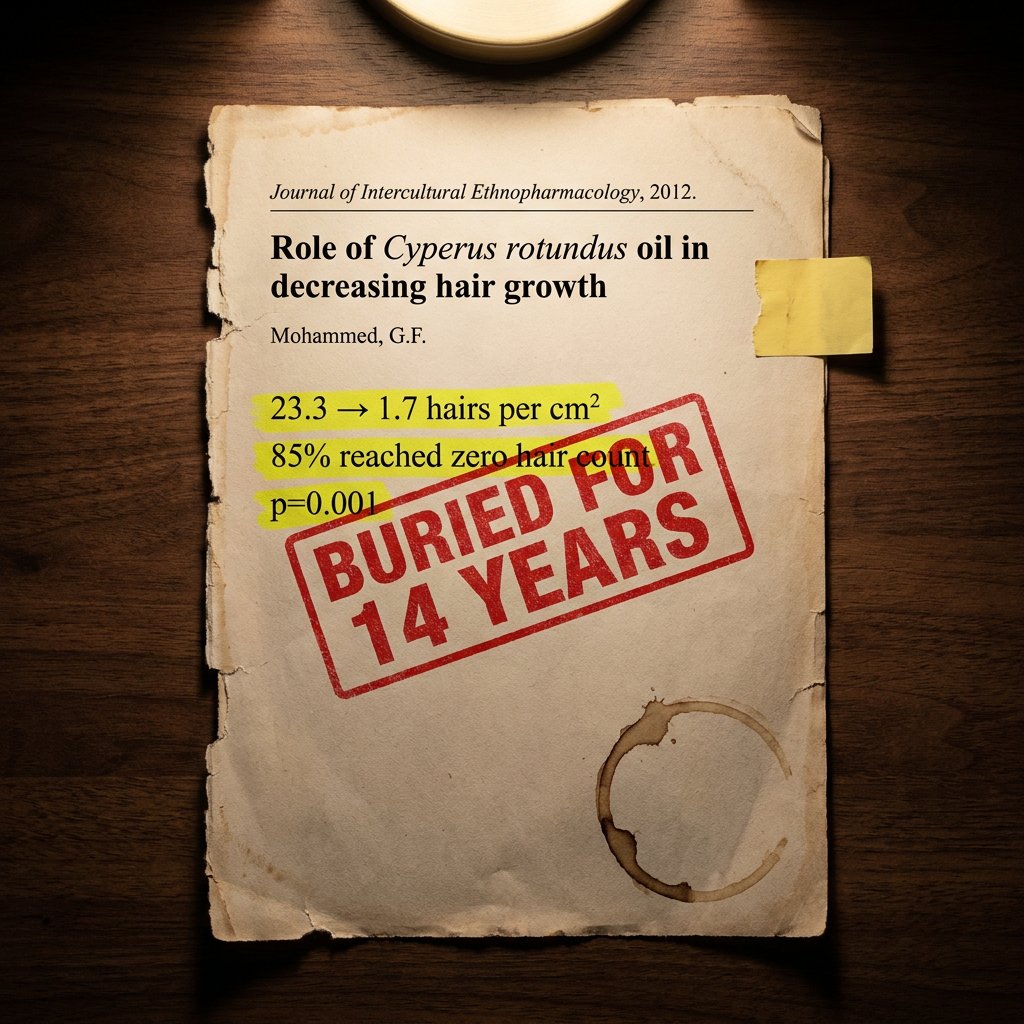
Before I spent a dollar, I wanted to see the research myself.
There are two studies that matter. Both are published. Both are peer-reviewed. Both have been quietly sitting in medical journals for over a decade while the hair removal industry acts like they don't exist.
I read both studies. I paid $38 to download the full PDFs. I'm not a scientist, but I know how to read a results section.
They're real.
They've been sitting there, buried, for 14 years.
The Ritual Finally Has a Name. It's Called Filara.

Here's what arrives in the box:
- A rechargeable rotary threading device, hand-sized, that performs the ritual in 3-5 minutes without requiring you to learn the two-hand-and-teeth technique. The device itself lasts years. A single charge gets you through weeks of use.
- A bottle of cold-pressed Cyperus rotundus oil, ethically sourced from traditional growers. Applied twice daily (morning and night) to the threaded areas between sessions. One bottle lasts about a month of twice-daily use on chin + upper lip — refills are $18 and ship whenever you need another one. No subscription required.
- A spool of fresh cotton thread for the device (the only consumable — you'll replace it every few sessions). Refill spools are $9.
- A linen waffle-weave storage pouch (so you can throw the kit in your bag when you travel).
- "The Ritual" — a short printed eBook that walks you through the protocol. Week-by-week guidance, troubleshooting, and the full history of the ritual as Dr. Haddad's grandmother taught it.
The protocol is the exact one Dr. Mohammed used in the 2012 and 2014 studies:
- Thread the area (chin, upper lip, jaw, or wherever you're treating) once every 3 weeks. Takes 3-5 minutes per zone.
- Apply the oil twice daily — morning and night — to the threaded areas in between sessions. 2-3 drops, massaged in.
- Track your results at the 3-month and 6-month mark. That's how long the study ran.
That's it. No forced monthly fee. No auto-shipping surprises. No "you must come back for 6 more sessions." No "your results may vary unless you buy the follow-up package."
You buy the kit once. You run the ritual. The research says the follicle slows down.
Why This Works When Nair, Laser, IPL, and Vaniqa All Failed
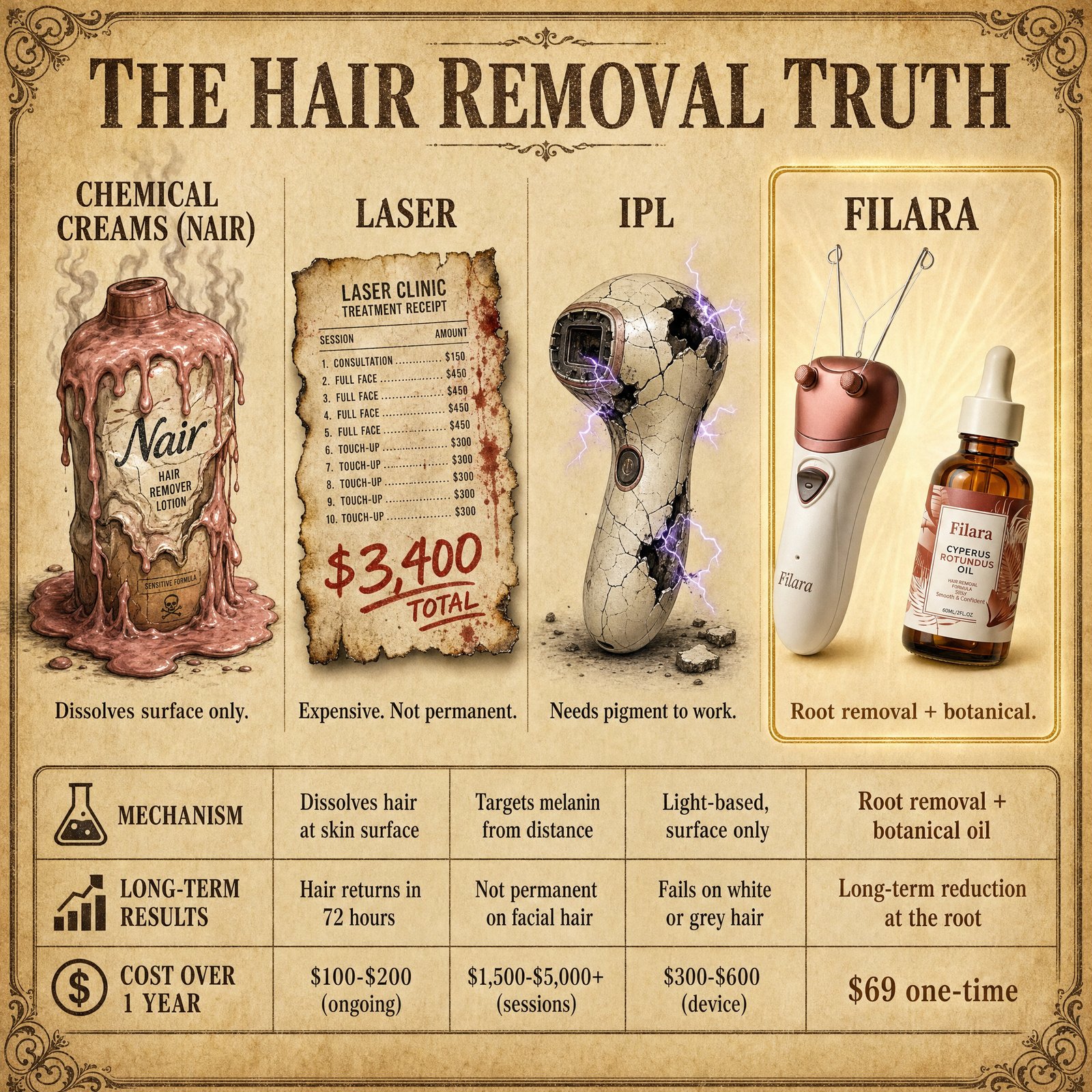
Look at the chart above. The thing that nobody in the industry wants you to look at.
Every method except one treats the symptom. The one that treats the mechanism — the actual follicle cycle — is the one with no recurring revenue model. Which is why you've never seen it advertised during a prestige TV show.
Filara is the first (and currently only) U.S. company packaging the ritual as a kit. Dr. Haddad's grandmother would have been proud. Dr. Haddad's team spent two years sourcing the oil from the right growers, designing a device that doesn't require two decades of threading practice to use, and getting both studies translated and vetted for American regulatory review.
It's not magic. It's not a hormone treatment. It's not a secret miracle.
It's a 5,000-year-old ritual, finally built as a kit, finally available in the U.S., finally priced within reach of a woman like me.
1,847 Reviews. 4.7 Stars. Here Is What Finally Convinced Me.
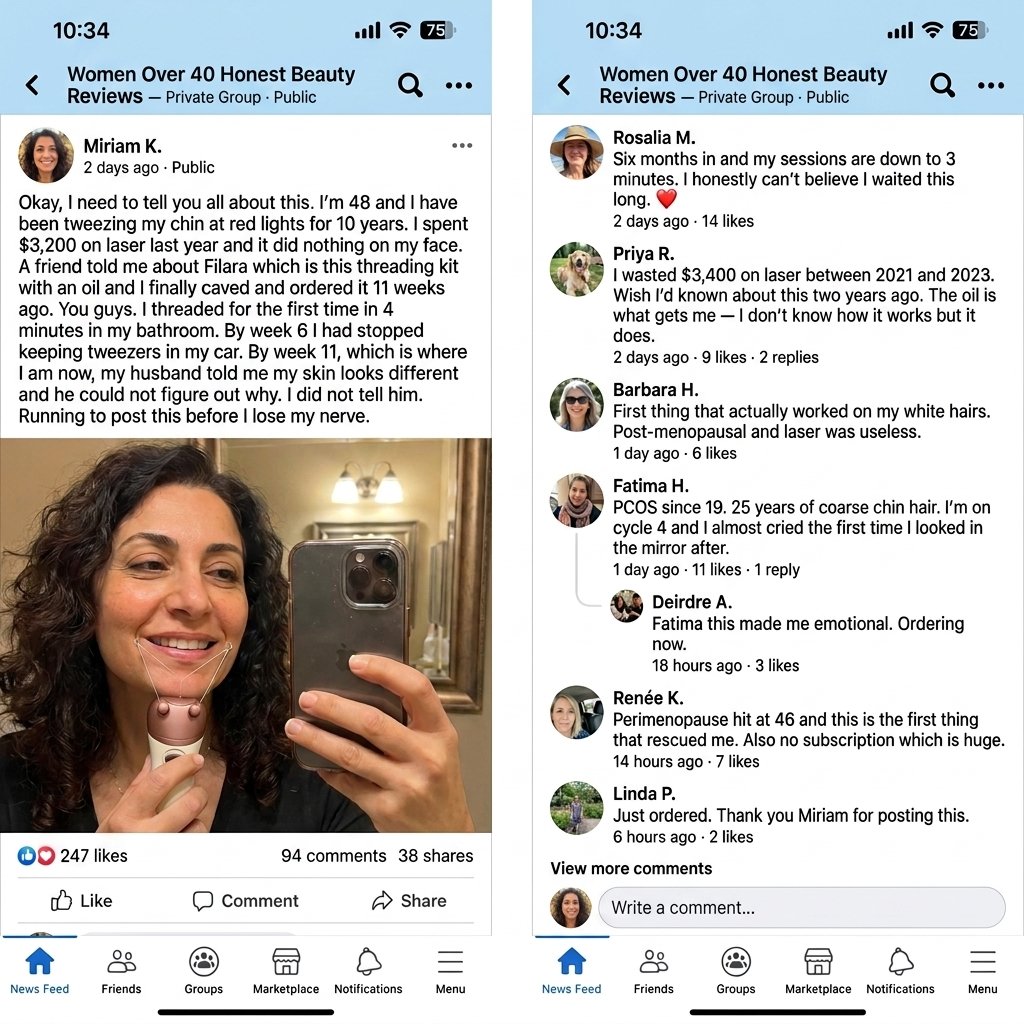
I read every single one-star and two-star review before I ordered. (I'm that woman.) The negative reviews were overwhelmingly about shipping delays and one woman who said the threading device gave her a mild red mark that faded in a few hours. Nothing structural.
The five-star reviews I kept coming back to:
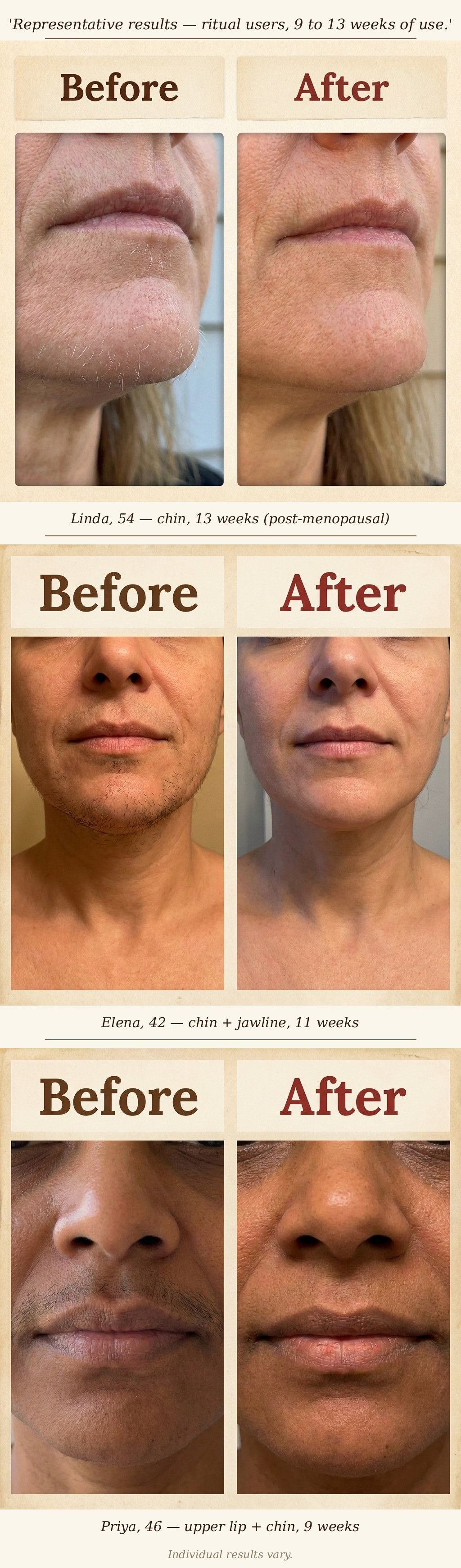
"I'm 46. I've been doing laser for 3 years and still had hair. 11 weeks on Filara and my chin is smooth. I keep touching it. My husband asked what I'd done. I didn't tell him." — Priya R., verified buyer
"Post-menopausal, 55. Laser didn't work on my white hairs. Nothing did. This is the first thing. I almost cried the first time I ran my hand along my jaw and felt nothing." — Barbara H., verified buyer
"PCOS since I was 19. 25 years of coarse chin hair. I'm on cycle 4 of the Filara ritual and I almost don't recognize myself in the mirror. I am a different woman." — Fatima H., verified buyer
"I kept it in my purse for the first three weeks because I didn't believe it would work and I didn't want my sister to see it. Now I keep it on my bathroom counter. I showed it to my sister. She ordered one." — Deirdre A., verified buyer
"Perimenopause hit at 46 and this is the first thing that rescued me. Also no subscription which is huge. I'm so tired of monthly charges." — Rosalia M., verified buyer
$5,705 on Everything That Failed. $69 for the Thing That Worked.

Let me show you what my shoebox of receipts looked like, before I burned them in my fire pit the week my Filara kit arrived:
- Laser clinic (6 sessions + consultation): $3,400
- Vaniqa prescription (8 months, $200/mo): $1,600
- At-home IPL device (that didn't work on my white hairs): $280
- Three different chemical creams (Nair, Veet, Nad's): $120
- Dermaplane tool + blades: $85
- Salon threading (every 2 weeks for 6 months): $220
Total spent on things that didn't work: $5,705
Price of the Filara Threading Kit: $69 (today — $118 regular price).
The device lasts years. The oil is a six-month supply. Refill oil is $18 per bottle. There's no subscription. There's no monthly fee. There's no "you must come back for 6 more sessions."
Over the course of one year, Filara costs you under $150 total. Laser costs $1,500 to $5,000+. Vaniqa costs $600 to $900. Chemical creams cost $100-200 on ongoing refills.
I spent 83x more on treatments that failed than I did on the one that worked.
60 Days to Try It. Full Refund If It Doesn't Work.

Here's what makes this offer different from anything a laser clinic or a subscription cream would ever hand you:
You get the Filara Threading Kit today for $69. You run the ritual for 60 full days. That's two full cycles of the protocol — enough time to see whether your regrowth is slowing, your hairs are coming in finer, and your sessions are getting shorter.
If none of that happens by day 60, you email the team one sentence:
"It didn't work for me."
They refund every dollar you paid.
You keep the device. You keep the oil. You keep the Ritual eBook.
No return shipping. No restocking fee. No mailing anything back to a warehouse. No questions. No forced auto-ship. No charge next month unless you choose to reorder.
I don't know of another product in this entire category that offers this. Laser clinics don't refund you if the laser didn't work on your white hairs. Vaniqa didn't refund me when it stopped working the moment I stopped using it. The $280 IPL device I bought has a 14-day return window and a 20% restocking fee.
Filara gives you 60 days. Full refund. Keep the kit.
That tells you something. Either the Filara team is reckless with their own money, or they already know — from the published research and from 1,847 reviews — that the overwhelming majority of women see results in those 60 days.
I'll let you decide which one it is.
What the Ritual Quietly Takes Away in 90 Days

Let me tell you what the last six months have looked like for me.
Week 0: I threaded for the first time in my bathroom. It took me 7 minutes the first try. I was clumsy with the device. The oil smelled like something between fresh grass and warm cedar — clean, mild. I applied it. Done.
Week 3: I threaded again. Already fewer hairs. The ones that came back were finer. I didn't trust it yet.
Week 6: Nora walked into the bathroom at 7am. I was at the mirror but I was just brushing my hair. She said "where are the tweezers?" I said "I don't need them anymore." She stared at me for a second and then hugged me without saying anything.
Week 12: I was at brunch with three of my closest girlfriends. One of them — Jen, 51 — asked why my chin "looked different." I almost cried in my mimosa. I told them everything. Two of them ordered Filara that night at the table.
Week 24 (now): I don't carry tweezers in my car anymore. I don't keep a hand mirror in my purse. I haven't been to the salon in four months. My husband kissed me on the chin last Thursday and I didn't flinch for the first time in six years.
That's what the ritual quietly takes away.
Not the hormones. Not perimenopause. Not aging.
Just the treadmill. The hiding. The 5am bathroom. The red-light tweezing. The $200/month subscription creams. The $65 salon lectures. The shame.
All of it. Gone.
In 90 days.
Every Day You Wait Is Another 30 Minutes Tweezing and Another 21 Days Pushed Back
I want to be straight with you about the math.
The Filara protocol works on a cycle. The first visible results come at the 2-4 week mark. Significant results come at the 8-12 week mark. The 85%-zero-hair-count number from the Mohammed study came at the 6-month mark.
Every day you wait to start is a day the cycle hasn't begun.
If you order today, you're smooth-chinned by Valentine's Day.
If you order three weeks from now, after you've "thought about it," you're smooth-chinned 21 days later than that. Which means another 21 days of 5am bathroom tweezing. Another 21 days of parking lot mirrors. Another 21 days of flinching when your partner leans in. Another 21 days of your daughter noticing.
You've already waited long enough. We all have.
If you've read this far, you already know. You've already done the math on $5,705 of failed treatments. You've already seen the research. You've already read the reviews.
The only thing between you and the end of the treadmill is one order.
$69 Today. $118 Tomorrow. Stop Fighting. Start the Ritual.

— Lauren R.